
Speaking & Executive Education
Practical Healthcare Transformation From an Operator Who Has Led It
Most healthcare transformation conversations focus on technology.
Very few focus on the operational systems required for technology, AI, automation, and workforce redesign to actually succeed.
That gap is where many organizations struggle.
Abraham Doolhoff is a healthcare executive, operator, and speaker who helps healthcare leaders understand why operational clarity, workflow design, and execution discipline matter more than hype, vendor promises, or technology alone.
Drawing from leadership experience across academic medicine, ambulatory operations, access transformation, surgical services, digital transformation, and large-scale operational redesign, Abraham delivers practical, experience-based presentations designed for healthcare executives, operational leaders, physician leaders, healthcare administration programs, executive education audiences, and industry conferences.
Presentations combine real operational examples, strategic frameworks, implementation lessons, and actionable guidance leaders can immediately apply within their organizations.
Speaking Topics
Care Team Redesign: Building Sustainable Care Models for the Future of Healthcare
Healthcare organizations cannot solve modern access, workforce, and capacity challenges simply by adding more staff into workflows that were never designed for long-term scalability.
Care team redesign focuses on ensuring the right work is performed by the right role, at the right time, with operational structures designed to support both quality care and sustainable growth.
Our work focuses on:
Top-of-license role utilization
Reducing provider administrative burden
Workflow and communication redesign
Throughput and capacity improvement
Workforce scalability planning
Operational alignment across clinical and administrative teams
These approaches are not theoretical.
Many high-performing healthcare organizations have utilized versions of these operational models for more than 20 years while continuing to maintain exceptionally high standards for patient care, patient experience, and operational performance.
The strategies reflected throughout this work are informed by leadership experience within nationally recognized healthcare organizations, including initiatives implemented at Mayo Clinic and large academic healthcare environments where care team redesign and workflow optimization have been continuously refined over time.
The goal is not simply to reduce labor costs.
The goal is to build operationally sustainable care models that improve access, reduce friction, protect provider time for high-value clinical decision-making, and support long-term healthcare delivery without compromising quality of care.
Healthcare’s Problem Is Not a Lack of AI: Why Automation Fails in Broken Systems
AI and automation continue to dominate healthcare conversations, yet many organizations still struggle to produce meaningful operational improvement from these investments.
This presentation explores why technology alone rarely solves operational dysfunction and why broken workflows, unclear ownership structures, fragmented decision-making, and poorly designed processes often prevent automation from delivering sustainable results.
Attendees will learn:
Why automation often amplifies existing operational problems
How operational clarity impacts AI success
Common causes of transformation failure
How to evaluate organizational readiness before implementation
Practical approaches for building scalable operational systems
Ideal audiences:
Healthcare executives, operational leaders, digital transformation teams, healthcare administration programs, executive MBA programs, innovation institutes, and healthcare conferences.
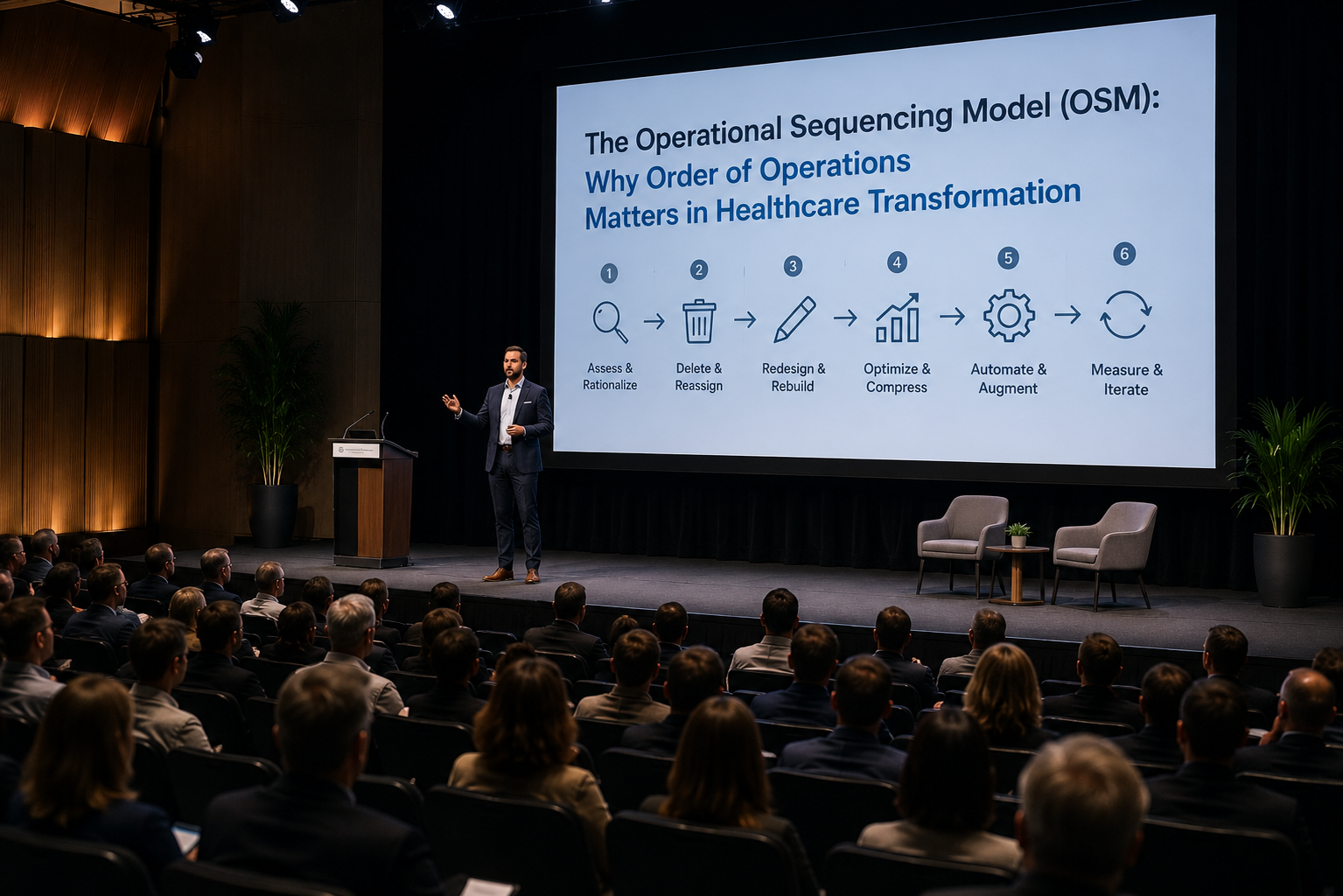
The Operational Sequencing Model (OSM): Why Order of Operations Matters in Healthcare Transformation
Many healthcare organizations attempt to automate, optimize, or digitize workflows before first understanding whether the underlying process should exist in its current form at all.
The Operational Sequencing Model (OSM) provides a structured framework for evaluating operational systems in the correct order to reduce waste, improve scalability, and support sustainable transformation.
The model focuses on six stages:
Assess & Rationalize
Delete & Reassign
Redesign & Rebuild
Optimize & Compress
Automate & Augment
Measure & Iterate
Attendees will learn:
Why organizations frequently optimize the wrong problems
How to identify operational friction points
Approaches for reducing unnecessary work
How to align operational redesign with technology strategy
Practical implementation lessons from healthcare operations
Ideal audiences:
Healthcare leadership teams, operational improvement groups, executive education programs, physician leadership institutes, healthcare operations students, and consulting organizations.
Access, Capacity, and Throughput: The Operational Constraints Limiting Healthcare Growth
Many healthcare organizations believe their primary constraint is provider capacity.
In reality, operational bottlenecks, fragmented workflows, intake inefficiencies, scheduling structures, communication gaps, and poorly aligned staffing models frequently reduce available capacity long before provider schedules are truly maximized.
This session focuses on identifying and addressing the hidden operational constraints impacting access, throughput, patient experience, and financial performance.
Attendees will learn:
Common operational bottlenecks limiting capacity
Why scheduling optimization alone is rarely sufficient
Approaches for improving throughput without simply adding staff
How workflow coordination impacts patient access
Operational strategies for sustainable growth
Ideal audiences:
Ambulatory leaders, physician groups, hospital operators, ASC leaders, access leaders, scheduling teams, healthcare administration programs, and healthcare conferences.
Vendor Selection Through the Lens of a Healthcare Operator
Many technology purchasing decisions are made using demonstrations, feature comparisons, and high-level promises without sufficient evaluation of operational fit, implementation realities, workflow integration, or long-term partnership alignment.
This presentation provides a practical operator-focused framework for evaluating healthcare vendors and technology investments more effectively.
Attendees will learn:
Why demos rarely reflect operational reality
Questions that significantly change purchasing decisions
Common implementation failures organizations overlook
How to evaluate operational alignment before signing contracts
Risk areas related to ownership, support, integration, and scalability
Ideal audiences:
Healthcare executives, operational leaders, procurement teams, digital transformation leaders, innovation teams, and healthcare MBA/MHA programs.
Presentation Formats
Available formats include:
Keynote presentations
Executive education sessions
Workshops
Leadership retreats
Conference sessions
Panel participation
Guest lectures
Virtual presentations
Healthcare leadership development programs
Sessions can be customized for:
Health systems
Academic medical centers
Physician groups
Ambulatory organizations
Rural healthcare organizations
Executive education programs
Graduate healthcare administration programs
Industry conferences